

The e-book is a recent invention that reached maturity relatively fast. In 2025, the e-book market size was valued at USD 50.61 billion, and about 31% of American adults reported reading an e-book in the past year.
From its earliest origin to the rise of advanced reading devices, the e-book has earned its place as a tectonic change in the history of publishing. It brought a revolution in reading habits and fueled dark predictions about the death of the book.
World E-book Day is celebrated on July 4th, commemorating the creation of the first e-book, attributed to Michael Hart in 1971, in Illinois. With that in mind, this article traces the history of the electronic book: its antecedents and precursors, its many forms, and how it has evolved since its origin.
What is an E-Book?
Before diving into the history of the e-book, we should ask one question: What exactly is an e-book? Is it simply a book read on a screen? A combination of zeros and ones? A series of electronic impulses? Does a scanned or photographed book count as an e-book?
Defining the term is less straightforward than it seems. The New Jersey Institute of Technology defines it as follows:
An e-book (short for electronic book, also written eBook or ebook) is an e-text that forms the digital media equivalent of a conventional printed book, sometimes protected with a digital rights management system. Ebooks are usually read on personal computers or smartphones, or on dedicated hardware devices known as e-book readers or e-book devices. Many mobile phones can also be used to read e-books.
This definition mentions only one conception of the e-book: the digital version of a printed publication. However, it leaves out another definition of the term: any digital content organized as a book, which includes works that were never printed and were created entirely with digital tools.
It’s also worth drawing a distinction between an e-book and a digitized physical book: the first one is a book (with or without a printed version) designed to be read on an electronic device. A digitized book, by contrast, is a physical book that has been digitized to be read on a screen.
A second definition comes from Marianela Camacho Alfaro, writing in the Journal of Modern Languages (No. 20, 2014) of Costa Rica:
Electronic books or e-books are digital books, that is, files. As files, they can be opened and read on a computer, using various paid and free reading apps, as well as on portable devices: e-book readers, or e-readers, smartphones and tablets.
Alfaro also points to an ambiguity present in the term itself: e-book is often used to refer to both the content and the storage device. Even the Collins Dictionary stumbles into this when it defines the term:
- a written work whose text, etc. is published in digital form
- a portable electronic device with a video screen, for reading such a work
But while the distinction matters, the close relationship between the two is also important. David Caldevilla Domínguez, of the Universidad Complutense de Madrid, makes this point by quoting the historian Roger Chartier:
The electronic book, like the printed one, contains something fundamental: content written in textual form, something that, in this new invention, becomes intertwined with the medium that houses it and favors its dissemination and commercialization. Because, without a medium to support it, there is no text to be read (Chartier R., 2000).
Types of E-Books
As we mentioned in the previous section, it’s one thing to talk about the e-book and another to talk about the e-readers and other devices used to read them. In the first case, we are referring to the file formats that contain the book’s content, including:
- Plain Text (.txt). The earliest text format used by word processors, based on standards such as ASCII, was developed in 1963 by the American Standards Association.
- HTML (HyperText Markup Language). Created in 1991, this format made it possible to create websites with the hypertext technology to link different sites and multimedia content, and browse the Internet.
- PDF (Portable Document Format). Introduced by Adobe in 1992 for reading digital documents, including books, regardless of the type of software, hardware, or operating system used. While not ideal for e-books on reading devices, it remains one of the most widely used formats for reading and sharing documents online.
- ePub (Electronic Publication). Developed by the International Digital Publishing Forum (IDPF) in the late 1990s, its first official version was released in 2007 with Amazon’s Kindle. It uses web standards such as HTML, CSS, and XML, and is currently an open format compatible with most e-readers on the market.
- MOBI (Mobipocket). It was created by the French company Mobipocket in 2000 for the publication of e-books. In 2005, the company was bought by Amazon, and the format became a standard for Kindle until the AZW and AZW3 formats appeared in 2007.
- AZW and AZW3 (Amazon Word). These proprietary formats developed by Amazon were first used on Kindle devices in 2007. They are not compatible with most non-Amazon readers, and they integrate digital rights management (DRM) technology to limit unauthorized copying and distribution.
History of the E-Book
Since its earliest version, the e-book has evolved depending on the medium in which it was stored and transmitted. Therefore, before talking about its origin, it’s worth mentioning some of its antecedents:
- The first types of media to contain “digital” text were microfilm and microfiche, photographic storage media that were used since the early 20th century to reduce the size of documents for storage or distribution, such as books and journals that could be consulted on computers.
- Another way of storing and saving information was magnetic tape, which was widely used during the 1970s and 1980s for purposes similar to those of microfilm.
- In the 1970s, the floppy disk was born, the first medium that allowed digital book files to be transmitted and accessed on compatible computers.
- In early 1980, the compact disc, or CD, appeared as a way to commercialize music and, a few years later, in 1985, the CD-ROM was introduced. Both are aluminum and polycarbonate discs on which information is recorded with laser technology and later reproduced by a reader using the same technology on a computer.
Doña Angelita’s Mechanical Encyclopedia
There are many predecessors of the e-book, and each one can be linked to a different technological advance of the 20th century. However, the Mechanical Encyclopedia of Ángela Ruiz Robles, better known as Doña Angelita, deserves a special mention. This is because hers was the first device used as a book.
Indeed, in 1962, Ms. Angelita registered the patent for a mechanical book consisting of several parts. Technically, it was not an e-book, but we can say that the idea behind the device anticipated a text navigation system similar to hypertext. On the left side, it had a series of letters that allowed users to form words, expressions, or phrases to search for topics. Above the letters (in several languages, by the way), it had two coils for linear, ornamental, and figure drawings.
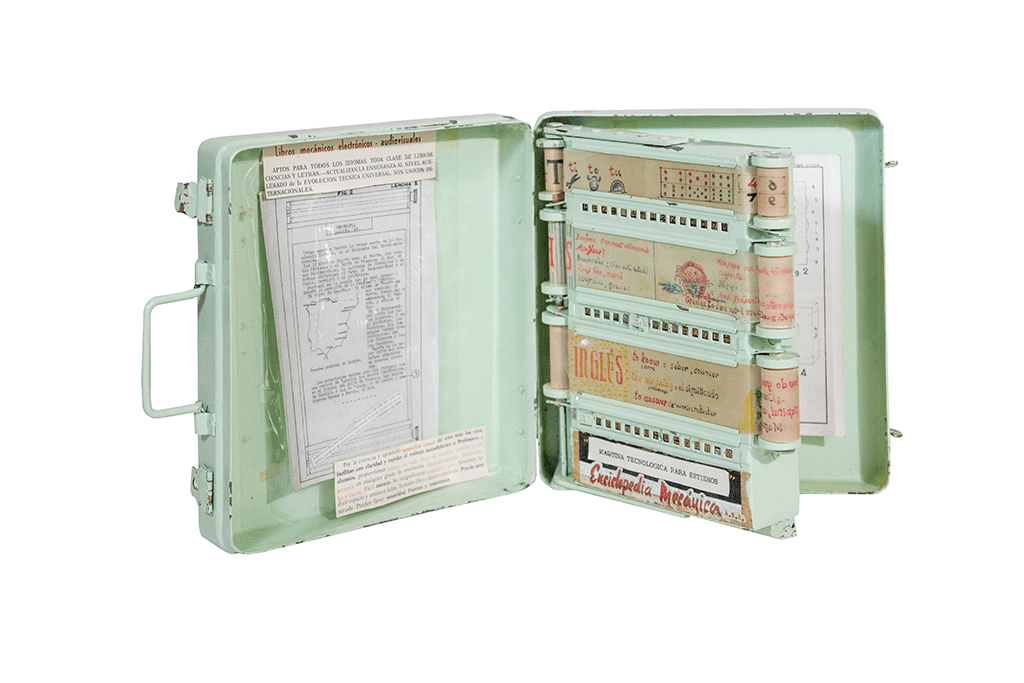
Under the letters, the device had a plastic surface for writing, annotating, operating, and drawing, and inside it had a compartment to store the subjects. In the right part of the book, behind a plastic sheet, the subjects could be read with an internal light, and it had two coils on the sides that were used to navigate through them.
While Doña Angelita received great recognition for her invention, she failed to secure funding for her encyclopedia, so she could only produce a prototype. However, her grandson, Daniel González de la Rivera, said:
My grandmother’s invention was a huge revolution at the time. It meant changing almost all paper support to spool support. A change for publishers and especially for young people’s way of learning.
E-Book Origin and Evolution
The origin of the e-book is attributed to Michael Hart (1947-2011), a student at the University of Illinois who, in 1971, transcribed a copy of the United States Declaration of Independence into digital format using the university’s computer system (a Xerox Sigma V mainframe). After recognizing the potential of text digitization, Hart undertook the task of collecting universal works to digitize and make available to the public: this marked the birth of what would become known as Project Gutenberg.
Michael Hart is credited with the origin of the e-book because, thanks to him, the digitization of books became a phenomenon with massive potential reach. Let’s remember that, in 1971, the first email communication between two central computers had only recently been achieved.
Other sources, however, attribute the origin of the first e-book to the Index Thomisticus, by the Italian Roberto Busa, in the 1940s. It’s a 56-volume work that includes all the works of Saint Thomas Aquinas, of which Busa gathered about ten thousand tokens that he hoped to link in an automated way.
Busa is considered a precursor of computational linguistics and hypertext precisely because he conceived his Index with the possibility of linking the different fragments of the work of Thomas Aquinas to navigate it as we do today on the Internet. He had the help of the computer giant IBM, which took 15 years to complete the project and gave the name hypertext to the mechanism that makes its operation possible. Busa’s work was published on CD in the early 1990s and later on DVD. His contribution to the development of hypertextuality and computational linguistics was critical.
First Commercial Steps in the History of the Book
It was only in 1985 that the Voyager Company was founded, a pioneer in the creation of the CD-ROM, a laser-engraved disc capable of hosting not only text, but also multimedia content. This led to the so-called “expanded books” in 1991, designed to be read on a computer screen, with titles such as Jurassic Park, by Michael Crichton.
Later, in 1993, Digital Book, Inc. began selling digital books on floppy disks. In the same year, the company Bibliobytes launched its online book-selling website and became the first company to create a payment system for selling books online. In 1995, Amazon recognized the potential of this market and launched its online bookstore with around 200,000 titles.
Technological Innovations and Reading Devices
In 1997, the Media Lab at the Massachusetts Institute of Technology (MIT) began the development of electronic ink. By avoiding the reflection of light on the reading device screens, this technology allowed for a more comfortable reading experience and improved battery performance, although a prototype was not launched until 2002.
In 1998, the first devices created exclusively for digital reading were launched: the Rocket eBook readers, from NuvoMedia, and the SoftBook, from SoftBook Press. Although neither had the functions e-readers have today, they helped define the standards for the creation of e-readers and e-books, and later the creation of the EPUB format. That same year, the first ISBN number for an e-book was registered.
First E-Book Publishing Imprint and Business Expansion
A year later, in 1999, the American publishing house Simon & Schuster created its iBooks imprint, the first of its kind, dedicated to editing and publishing electronic books, with authors such as Arthur C. Clarke and Raymond Chandler. Around the same time, public libraries in the United States began offering e-books for free through their websites.
The first years of the new millennium saw the expansion of the e-book, with milestones such as the publication of the novel Riding the Bullet, by Stephen King, in digital format. It sold around 500,000 copies in just two days, revealing the potential of the digital market. As a result, Random House and HarperCollins began commercializing digital versions of their books. In 2004, the Sony Librie was released, and two years later, it was the turn of the Sony Reader. That same year, the first reader using electronic ink was commercialized.
E-Book Consolidation
In 2007, with the launch of Amazon’s Kindle, the digital book reader became consolidated. The arrival of Apple’s iPhone also represented a huge advance in mobile technology, since it was no longer necessary to have a specific device for mobile reading. This decade saw a race among the leading technology companies: Apple, Amazon, Sony, and Google competed to control the digital books market.
The new reading devices incorporated different functions that allowed users to interact with books, such as adding bookmarks, highlighting text, making annotations, and searching for words directly on the device. Responsive design was added so that the text could adapt to the device’s size and give users the possibility of modifying the size and type of font used. In addition, snippets of text could be copied and pasted to be shared with other readers, either via email or social media.
By 2011, e-book sales had exceeded paperback sales on Amazon, and the following year, total e-book sales in the United States exceeded total hardcover sales for the first time in history, with nationwide revenue of more than $3 billion. By the end of 2013, e-books accounted for 20% of the U.S. book market.
Conclusion
This has been the history of the e-book, with its predecessors, advances, and evolution. At Palabra, we are passionate about books and eager to help authors turn their dreams into reality. If you need a hand with your next project, feel free to contact us!


Un comentario en “History of the E-Book”