
Using caps—How hard can it be? We all know that proper nouns (like España and Mónica) are written with an initial capital letter in both English and Spanish. After a period, we also write an initial capital letter, of course. So far, so good, and we can all agree on that. How many more rules or questions about it can there be?
Well, actually, there are many questions about caps in Spanish that may arise, especially for English speakers. For example, is the sun a proper noun? Is it “el sol” or “el Sol”? After a colon, do we need to capitalize? Are months and days of the week capitalized in Spanish? In this article, we’ll get some basic notions, comparisons with English caps rules, and we’ll answer these FAQs regarding the use of caps in Spanish and more.
Use of Caps in Spanish: Basic Notions
First things first, when do we use caps in Spanish? If we want a more detailed explanation, we can dive into the Diccionario panhispánico de dudas, which goes into every little aspect regarding the use of caps in Spanish. However, in this article, we will sum up (and dumb down) those rules’ basic elements.
1 – Caps in Proper Nouns
As we have already mentioned, and we all know, proper names should be written with initial capital letters, and this applies to both English and Spanish. In this category, we include:
- First names and last names: like “Juan Sánchez”, “María”, and “González”
- Geographic places: like “Francia”, “Buenos Aires”, and “Londres”
- Names of deities: like “Zeus” and “Poseidón”. When it comes to God, however, we should write it in caps when we use it as a proper name (“Los católicos creen en Dios”), but we write it in lowercase when we talk about the common noun (“Después de la ayuda que le brindó ayer, ella es su dios”).
- Nicknames: like “Che Guevara”, or “Chapo Guzmán”.
- Cardinal points: Cardinal points are written in caps only when we refer to their main meaning (for example, “la brújula apunta al Norte”). However, when we talk about an orientation, we don’t write it in caps (for example, “el sur de Italia”).
- Zodiac signs: They should always be capitalized, except when we use them to talk about people. For example, we say, “Juan es de Leo”, but “Los sagitario me caen mal”.
- Brands: like “Chupa Chups” and “Corona”.
- Ages and periods: like “Edad Media”, “Renacimiento”, or “Paleolítico”.
2 – Initials and Acronyms: How Should We Write Them?
Just like in English, in Spanish, all letters that form an initial are written in uppercase and, when we use the full form of the words that make up the initial, all words should be capitalized. In this way, for example, the IMF in Spanish is written “FMI”, which stands for “Fondo Monetario Internacional”.
Besides, initials in Spanish are never written with periods in between the letters (we write “OMS” to talk about the “Organización Mundial de la Salud” (WHO), and not “O.M.S.”), and they never take an “s” at the end to refer to their plural form. So, for example, while saying “DVDs” is correct in English, it would be incorrect in Spanish, where the article alone indicates if the initial is being used in its singular or plural form (“el DVD” and “los DVD”).
Acronyms, on the other hand, are the initials that can be read or pronounced as a single word. Frequently, they are incorporated into the Spanish lexicon and, therefore, aren’t capitalized. For example, “ovni” (which stands for “objeto volador no identificado”, UFO) has been incorporated into the Spanish lexicon, and so it isn’t capitalized. When the acronym has been incorporated in the Spanish lexicon, and it is a proper noun, we should follow the previous rules of capitalization and only write the first letter in capital letters, as in “Unesco” or “Unicef”.
3 – Caps After Punctuation Marks
After a period, we start the next sentence with caps, of course. But what happens with other punctuation marks? Should we add a capital letter after a question mark? What about after a colon? Let’s dive into all of that.
- After closing question or exclamation marks: After the closing signs, we capitalize unless the same sentence continues after the mark.
- ¡Fue genial la fiesta de ayer! Qué lástima que no llegaste a tiempo.
- ¿Qué comemos hoy? fue la pregunta que destruyó nuestra relación.
- After opening question or exclamation marks: After the opening signs, we can use either uppercase or lowercase; which one we use will depend on the context. If the question starts in the middle of a sentence, we will use lowercase, but if the question begins a new sentence, then we should capitalize.
- ¿Cómo te llamas?
- Discúlpame por preguntártelo de nuevo, pero ¿cómo te llamas?
- After ellipses: If a sentence ends with ellipses, the next sentence should start with a capital letter. However, if the ellipses indicate a pause and the sentence continues after it, we should start in lowercase.
- Jorge ya se había dado por muerto… Siguió caminando solo por la inercia.
- Creo que… te aceptaré otro café.
- After a colon: Generally speaking, there shouldn’t be an uppercase letter after a colon in Spanish. However, if the colon introduces a direct speech, a name, or a full sentence, we should continue in caps.
- Debemos comprar: leche, cereales y frutas.
- Querido Juan: Te escribo para hacerte una pregunta.
- En ese momento, Javier dijo: “Tengo que confesarles algo”.
- Advertencia: Este producto puede contener maní.
4 – Caps in Subjects and Fields
Subjects, degrees, diplomas, and majors of study should be capitalized in all meaningful words in Spanish. In this way, we say “Administración de Empresas”, “Literatura”, “Comercio Exterior”.
However, when we talk about a field of study, we should write it in lowercase. For example, “A Marta siempre le gustó la psicología; por eso, comenzó a estudiar Psicología en la universidad”. In this case, “psicología” is first used to talk about the field of study, and then it is capitalized to talk about the major that Marta started studying at university.
Furthermore, titles or positions like “licenciado”, “doctor”, and “profesor” are never capitalized.
5 – Institutions
We capitalize names of institutions, government bodies, public establishments, and political parties, like “Ministerio de Salud”, “Casa de Gobierno”, and “Partido Comunista”.
However, we should note that, while they are sometimes called by the same name, institutions are capitalized, but the buildings or professions related to them are not. For example, when we talk about “la Iglesia” as an institution, it should be capitalized, but when we are talking about “la iglesia” as a building, we use lowercase.
- La Iglesia es un consuelo para los cristianos.
- El supermercado está frente a la iglesia.
The same happens with the word “policía”, which should be capitalized when we talk about the government body, but isn’t capitalized when we are talking about a single police officer, or the police station.
- La Policía debe cuidar a los ciudadanos.
- Un policía nos echó del bar.
- A una cuadra del supermercado está la policía.
How to Change Lowercase and Uppercase in Microsoft Word and Google Docs
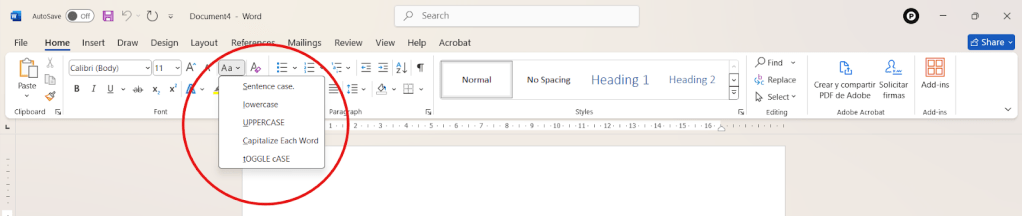
Besides using the Shift and Caps Lock buttons while we write, word processors have a useful tool that allows us to change between lowercase and uppercase.
In Microsoft Word we have five options to choose from: “sentence case” (all letters in lowercase except for the first one and after a period), “lowercase” (all letters in lowercase), “uppercase” (all letters in uppercase), “capitalize each word”, and “toggle case” (the initial of each word in lowercase and the rest in upper case).
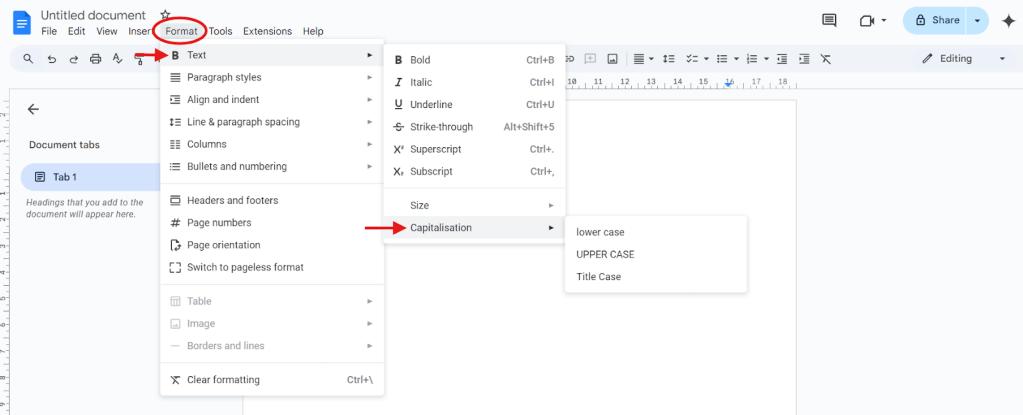
In Google Docs, we only have three options: “lower case” (all letters in lowercase), “upper case” (all letters in uppercase), and “title case” (capitalizes the initial of each word). However, what Microsoft Word calls “sentence case” is the default in Google Docs (and in Microsoft Word), and so it is automatically chosen.
FAQs Regarding Capitalization in Spanish
Now that we know the general rules of capitalization in Spanish, let’s answer some common questions regarding capitalization, focusing on the differences with respect to the capitalization rules in English.
«Internet» should be capitalized?
The correct answer is—it depends! Just like “iglesia” and “Iglesia”, the word “internet” in Spanish should be capitalized when we are talking about it in the broad sense, but shouldn’t be capitalized when we are talking about it as a service.
- Internet ha revolucionado la forma en que vivimos.
- Me quedé sin internet en mi casa.
Since we’re on the topic, “internet” is feminine or masculine in Spanish? Well, lucky for you, both are correct!
Do capitals take tildes (graphic accents)?
Yes! Even though in the times of typewriting and manual composition in the press, not including the graphic accent became popular, whether we are talking about capital letters used in initials or whole words, we should always add the “tilde” when applicable.
Are dates capitalized in Spanish?
No. In Spanish, neither the months nor the days of the week should be capitalized. The same happens with the seasons.
However, this changes when the date becomes part of a proper name, like in “plaza de Mayo” and “Viernes Santo”.
“Tierra”, “Luna” and “Sol” should be capitalized?
The words “tierra”, “luna” and “sol” should only be capitalized when we are talking about them in an astronomical context.
- El Sol es una estrella con luz propia alrededor de la cual gira la Tierra.
- Salió el sol.
- La luna está preciosa hoy.
Are demonyms and languages capitalized in Spanish?
Demonyms are words used to refer to a person who lives in a particular place or is native to that place. While in English demonyms are capitalized, in Spanish they shouldn’t be, so we write “mexicano”, “inglesa”, “francesa”, “turco”.
The only exception to this rule is when we use the demonym as a nickname, in which case it would be capitalized because it is used as a proper noun. For example: “Hoy voy a la casa del Ruso”.
In Spanish, languages aren’t capitalized either. However, they should be capitalized if we are talking about a subject or major, as we’ve seen before.
- “No sé hablar francés”
- “En la clase de Francés estamos aprendiendo los pronombres personales”
Should «Navidad» be capitalized?
In Spanish, the names of festivities should always be capitalized, whether they are religious or not. So we write “Navidad”, “Año Nuevo”, “Día de la Independencia.”
Should titles be capitalized in Spanish?
In English, all meaningful words in titles should be capitalized. However, in Spanish, we only capitalize the first word. So, while in English we would write The Lord of the Rings, in Spanish we write El señor de los anillos.
When we refer to the titles of books, movies, music albums, newspapers, and magazines, we capitalize only the first word and use italics. However, if we’re talking about chapters, songs, or articles, we capitalize only the first word and write the title between quotation marks.
- El primer capítulo de Harry Potter y la piedra filosofal se llama “El niño que sobrevivió”.
- El artículo “Cáncer de mama en México: una prioridad apremiante” se publicó en 2009 en la revista Salud Pública de México.
Conclusion
If you aren’t familiar with Spanish capitalization rules, you can apply almost the same rules as in English, but always remember that the capitalization of demonyms, dates, languages, and titles in Spanish is different.
You can also always check reliable sources like the Diccionario Panhispánico de Dudas’ website or Fundéu if any particular questions arise.
And, if you’d like a professional to proofread your Spanish text and check that all caps are correctly used, you can always reach out to us! In Palabra, a group of native speakers can proofread, edit, and even translate your text to ensure its quality.

